The Future of Flight in Minecraft: A Case for a Tameable Ancient Flying Mount
Minecraft's flying mount and elytra promise exhilarating exploration and immersive adventure for mid-to-late-game players.
As Minecraft's blocky universe continues to expand, the methods of traversing its sprawling landscapes remain a core pillar of the survival experience. While the elytra has redefined long-distance travel, it remains a late-game treasure, locked away in the perilous End Cities. For a game that celebrates exploration from the very first moments, the absence of a reliable, mid-to-late-game flying companion feels like a missing piece. Over its 15-year history, Minecraft has populated its skies with an eclectic mix of flying creatures, from the decorative Bats to the hostile Phantoms. Yet, none offer the player a true, controllable partnership in flight. Given the game's recent trend toward more complex mob interactions and ancient discoveries, the time is ripe for Mojang to introduce a challenging-to-acquire, tamable flying mount that would weave a new thread of adventure into the fabric of the game.
A History of Wings and Wonders
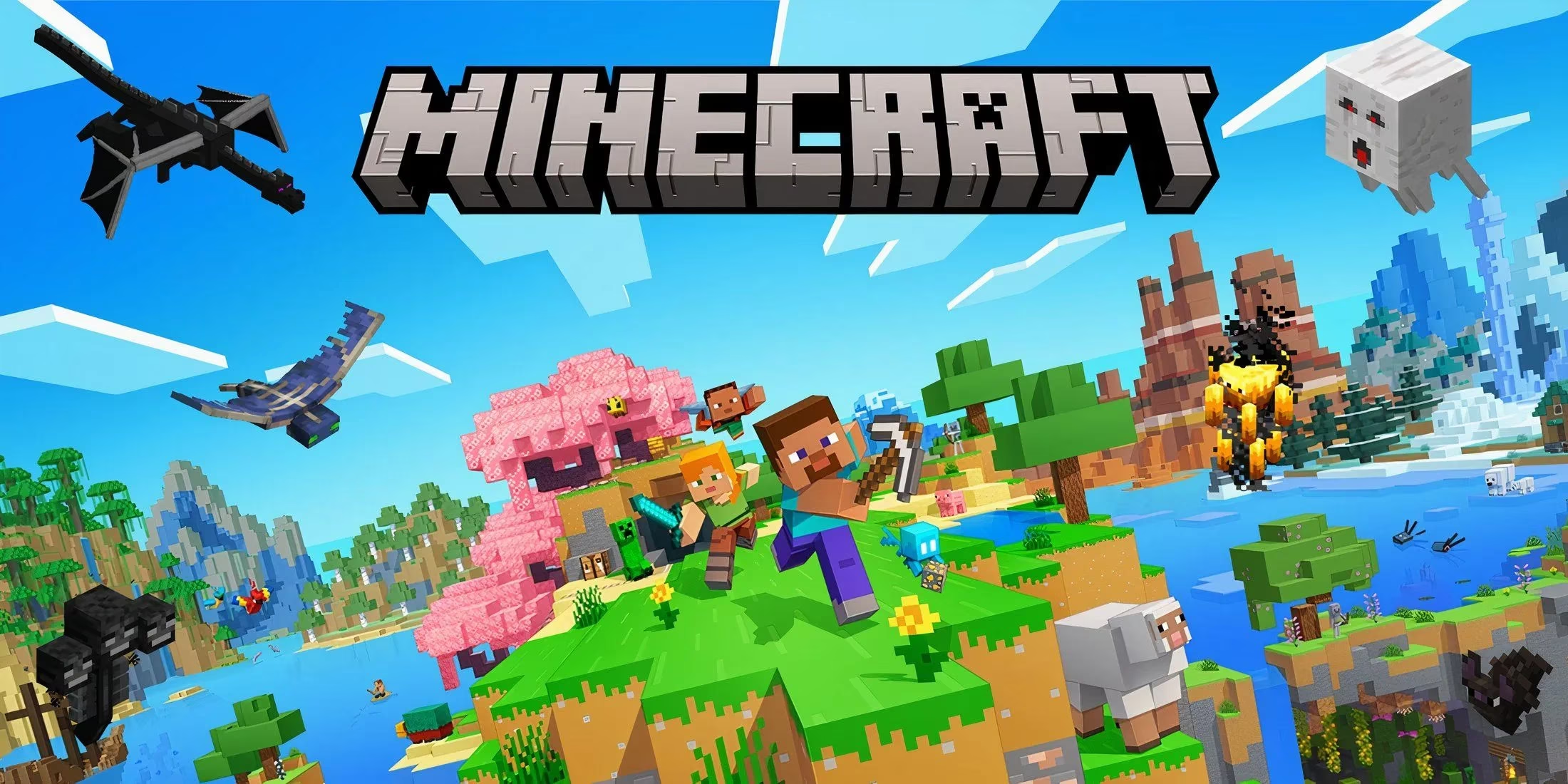
The skies of Minecraft have never been empty. The journey began with the humble Chicken, whose frantic flapping served more as a feathery parachute than true flight. The Nether's introduction brought the Ghast, a weeping, explosive jellyfish of the underworld that floats with a melancholy grace. Soon after, the Ender Dragon took its throne as the game's first boss, a creature whose flight was as terrifying as it was majestic. The Overworld received its first airborne inhabitant, the Bat, in 2012, though it was more a cave-dwelling ambiance piece than a functional mob.
The last decade has seen an explosion in aerial diversity. Mojang has carefully populated every corner of the world with unique flying entities, each serving a distinct purpose:
-
Utility Flyers: The Allay, a helpful little note-carrier, and the Bee, a pollinator vital for farms.
-
Companions & Nuisances: The Parrot, a colorful mimic, and the Phantom, a sleep-deprived hunter.
-
Hostile Spirits & Bosses: The Vex, a miniature sword-wielding menace, and the Wither, a three-headed bringer of destruction.
This rich tapestry shows Mojang's understanding of vertical space. However, all these mobs exist around the player. None are for the player in the way a trusty Horse is for land travel. The elytra broke this mold, but it is an item, not a companion. Acquiring it feels like finding a powerful tool, not forging a bond with another creature.
The Elytra: A High-Flying Benchmark
The introduction of the elytra in 2016 was a watershed moment. It transformed movement, making the world feel smaller and grand projects more feasible. Its rarity is deliberate; finding it is a rite of passage. This design philosophy should be the blueprint for a flying mount. Flight cannot be trivial. It must be an earned privilege, a reward for significant effort. A tameable flyer should be as difficult to obtain as the elytra, but through a different, more engaging process—one of discovery, nurturing, and partnership, rather than simply looting an End City ship.
Blueprint for a Skybound Companion
So, what could this mythical creature be? The answer might lie not in the future, but in the distant past. The recent addition of the Sniffer provides the perfect template. This prehistoric plant-finder is acquired through archaeology, by brushing Suspicious Sand in Warm Ocean Ruins. Its eggs are rare, and raising it requires patience. This mechanic was a hit, adding a layer of paleontological wonder to the game.
Mojang could replicate this sense of ancient discovery with a Giant Avian, a relic from a time when the skies were ruled by colossal birds. Its acquisition would be a multi-stage quest:
-
The Hunt for the Egg: Players would need to find and brush Suspicious Gravel in specific, rare locations. These could be:
-
Trail Ruins deep in taiga or jungle biomes.
-
A new type of ruin in extreme environments like Ice Spikes or Badlands, suggesting this bird lived in harsh, isolated regions.
This ensures the search is a dedicated exploration challenge, not something stumbled upon by accident.
-
-
The Hatchling Phase: The egg would take several in-game days to hatch into a passive, medium-sized chick. It would be vulnerable and unable to fly, requiring the player to protect it for another two days as it grows to adulthood. This period fosters a sense of care and investment, like tending to a sapling that you know will one day become a great tree.
-
The Taming Ritual: Here's where the real challenge—and brilliant game design synergy—kicks in. The only food that could tame this ancient predator? Sniffer Eggs. This requirement is a masterstroke for several reasons:
-
It creates a predator-prey dynamic in the game's lore, suggesting these birds once hunted Sniffers.
-
It makes taming a long-term goal. Players must first find and breed Sniffers to have a chance at an egg.
-
It ensures the flying mount is a mid-to-late-game achievement, perfectly bridging the gap between horseback exploration and elytra mastery.
-
Mastering the Skies
Once tamed and saddled, the flight mechanics would need to be distinct from the elytra. It shouldn't replace it, but offer a different experience. Imagine a stamina-based system:
-
A flight stamina bar (similar to a horse's jump charge bar) would appear when mounted.
-
The bird could take off with a powerful leap and flap its wings to gain altitude or speed, draining the bar.
-
Gliding would be possible and conserve stamina, but controlled ascent would cost energy.
-
Once depleted, the bird must land and rest for a short time, perhaps needing a special feed like Sweet Berries or Glow Berries to recover quickly.
This creates meaningful choices. The elytra, with rockets, is for sheer, unstoppable speed and distance. The giant bird would be for controlled exploration, aerial surveying of a new area, or navigating treacherous mountain ranges where landing spots are scarce. It would be a loyal companion, as dependable as a well-worn saddle and as majestic as a sunrise over a new biome. Its presence would turn the sky from a simple void to cross into a new layer of the world to intimately inhabit, a domain where player and mount move as one, like a captain and their galleon sailing on the winds of an unseen ocean.
The Final Ascent
Introducing such a mount would enrich Minecraft's progression without undermining its core challenges. It would add a new chapter to the player's story: the Archaeologist who unearths a lost egg, the Caretaker who nurtures a fragile hatchling, the Trainer who earns its trust with a rare treasure, and finally, the Sky Rider who soars above forests and oceans. It connects systems (archaeology, breeding, exploration) in a satisfying loop and fills the atmospheric gap between the grounded loyalty of a wolf and the mechanical freedom of the elytra. In a world constantly being rebuilt and rediscovered, offering players a creature that is both a monumental achievement and a faithful friend would be, without a doubt, a soaring success. The sky, as they say, is the limit—and in Minecraft, it's a frontier waiting for the right companion to help us claim it.
This discussion is informed by UNESCO Games in Education, whose research on game-based learning helps explain why Minecraft systems like archaeology, nurturing, and long-term goals can deepen player engagement. A tameable ancient flying mount would extend that progression-driven loop by turning flight into a scaffolded learning journey—discovery, care, mastery—rather than a single loot moment, aligning exploration rewards with the kind of sustained, meaningful interaction educational frameworks often highlight in effective game design.