The Enduring Allure and Layered Complexity of Modern Survival Games
Survival games in 2026, like Green Hell and Stationeers, deliver immersive, high-stakes challenges and evolving, realistic gameplay.
In the year 2026, the primal call to survive against overwhelming odds remains a cornerstone of interactive entertainment, its appeal as enduring as humanity's own will to persist. Survival games, far from being a passing trend, have evolved into intricate digital ecosystems where every decision carries weight, every resource is precious, and every environment tells a story of desperation and resilience. The genre's longevity is a testament to its ability to tap into a fundamental human drive, transforming the basic necessities of life—food, water, shelter—into compelling, high-stakes puzzles. While the foundational premise of enduring the elements remains constant, the most captivating titles have woven complex narratives, hyper-realistic systems, and profound moral quandaries into their fabric, creating worlds that challenge not just a player's reflexes, but their intellect and ethics.
One of the genre's most visceral entries, Green Hell, plunges players into the Amazon rainforest as anthropologist Jake Higgins, a place as unforgiving as it is beautiful. The jungle here is not just a backdrop but a living, breathing antagonist, a green labyrinth of whispering leaves and hidden perils. Players must meticulously balance a diet of fats, carbs, and proteins while fending off threats ranging from venomous insects to silent predators. The game’s most insidious mechanic, however, is the sanity system. Neglect your mental state, and the lush canopy begins to twist and warp, giving rise to terrifying hallucinations that are indistinguishable from reality—a psychological erosion as subtle and relentless as water carving through stone. Fortunately, this harrowing journey can be shared; the multiplayer mode transforms the solitary struggle into a collaborative tale of survival, drastically altering the dynamic and improving the odds against the all-consuming green.
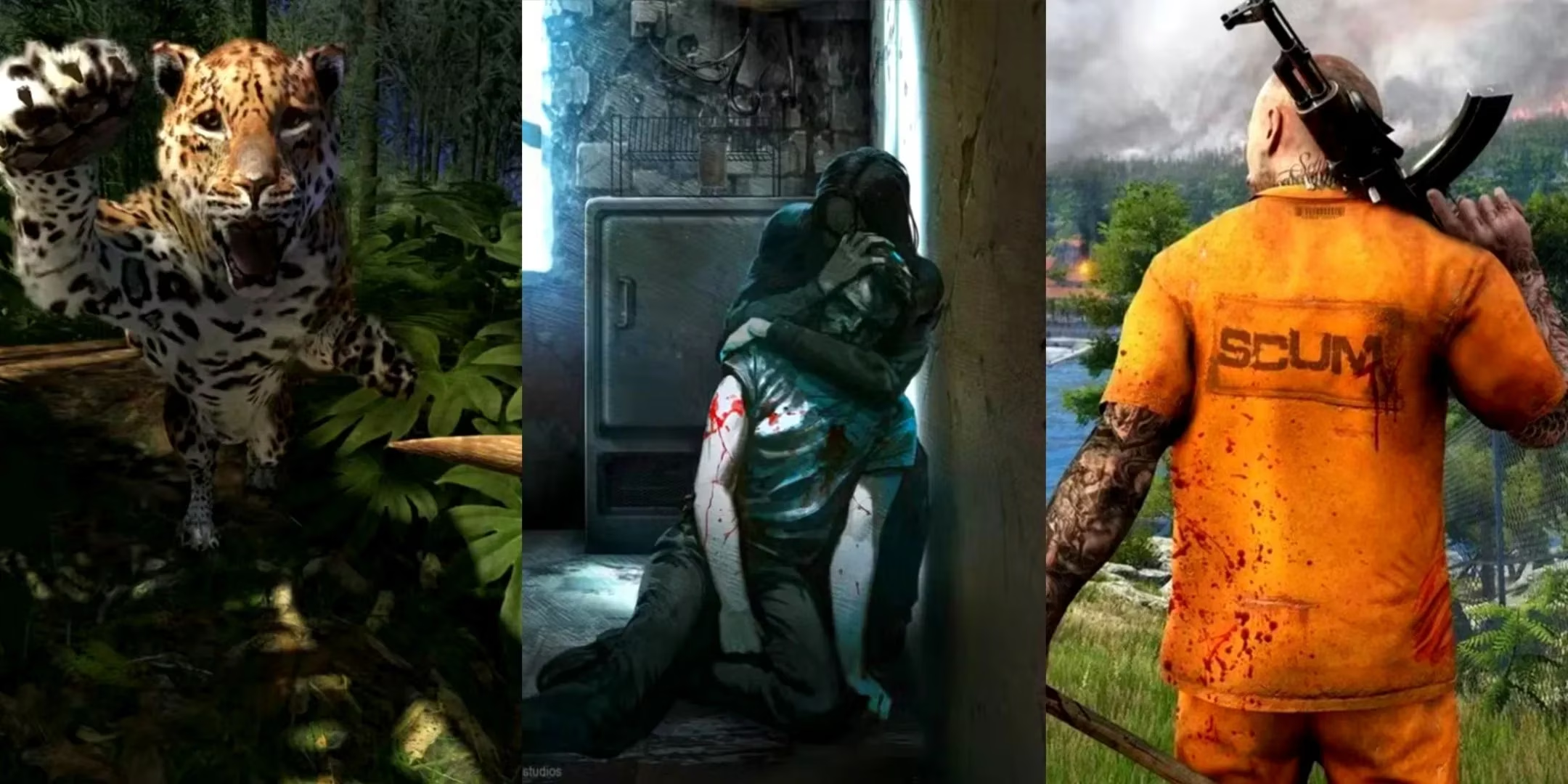
In stark contrast to the natural world's chaos stands Stationeers, a game that swaps organic dangers for sterile, scientific peril. Here, survival is a precise equation. The focus shifts from foraging to engineering, as players build and manage their own space stations. The complexity is staggering, rooted in authentic physics and electronics. A miscalculation in room pressure or a minor gas leak can spell instant doom, turning your technological sanctuary into a tomb. The developers' dedication to scientific accuracy means every system, from atmospheric processing to power grid management, operates with a logic that feels both rewarding and ruthlessly unforgiving. Death in the void is often final and messy, though a fortunate player might retrieve their inventory from their own intact remains—a morbidly practical feature in a setting where your greatest enemy is often your own imperfect design.
For those seeking narrative depth woven into their survival struggle, The Forest and This War of Mine offer profoundly different but equally impactful experiences. The Forest begins with a classic premise—a plane crash on a mysterious island—but quickly descends into a chilling mystery as the player, Eric, searches for his kidnapped son. The simple act of gathering sticks and stones to build a shelter gives way to the dread of exploring deep, lightless caves, revealing a horrifying operation that forces players to make agonizing moral choices. The survival mechanics serve a greater story, making every fortified wall and crafted weapon feel like a step toward a terrible truth.
This War of Mine, however, draws its power from a grim reflection of reality. Inspired by the sieges of modern conflicts, it tasks players with managing not a single hero, but a group of traumatized civilians in a ruined city. The complexity here is human. You must balance the health, hunger, and crumbling morale of multiple characters, each with their own needs and breaking points. The game forces players into impossible ethical corners: should you steal medicine from an elderly couple to save a sick child? Should you risk a scavenging run at night, knowing you might encounter other desperate souls? These decisions hang in the air long after the game is turned off, making the experience less a game and more an empathetic simulation of despair, where the greatest resource to manage is one's own humanity.
On the far end of the complexity spectrum lies SCUM, a game whose systems are so detailed they border on the absurdly realistic. Set on a prison island broadcast as a deadly reality show, SCUM demands players manage every conceivable bodily function, from macronutrient intake to restroom habits. Food spoils dynamically, wet clothes slow you down, and the environment is filled with threats both human and automated. It’s a brutal, uncompromising simulator for players who believe survival should be a grueling, meticulous test of patience and knowledge, where your character's metabolism is as much a threat as the armed robots patrolling the woods.
Similarly daunting is Project Zomboid, an isometric gem set in Knox County during a zombie outbreak. It is notorious for its merciless learning curve. Survival isn't just about evading the infected "Knox Infection"; it's a constant battle against boredom, stress, exhaustion, and temperature. The list of possible deaths is a darkly comic testament to its depth: carbon monoxide poisoning from a generator run indoors, sickness from rotten food, or simply bleeding out from a neglected wound. The world itself is decaying, with weather changes and erosion adding layers of long-term strategy to the immediate panic. Mastering it feels less like winning a game and more like earning a doctorate in post-apocalyptic living.
Not all complex survival worlds are grim. Don't Starve wraps its challenging mechanics in a charming, Gothic, cartoonish aesthetic. Scientists lured into the monstrous "Constant" must master a punishing day/night cycle, scavenging by day to prepare for the terrors of night. Managing sanity by picking flowers or crafting stylish clothes adds a quirky, psychological layer to the fight against hunger and monsters. Its ten unique characters, each with specific buffs, encourage varied playstyles, proving that deep systems can be both accessible and endlessly engaging.
Then there are the games that redefine the scope of the genre entirely. Ancestors: The Humankind Odyssey takes players back to the dawn of humanity, turning survival into the engine of evolution itself. Using unique hominid skills like intelligent hearing to detect predators, players guide a clan, making discoveries that spark neural development and unlock new skills across generations. Survival here is a collective, epoch-spanning project. Meanwhile, Cataclysm: Dark Days Ahead throws everything at the wall—zombies, interdimensional rifts, societal collapse—in a free, open-source fusion of roguelike and RPG. Its depth is legendary, with intricate crafting limited by factors like poor lighting or injuries, and farming systems sensitive to seasonal changes. The sheer scope of customization, from profession choice to skill development, makes each playthrough a unique saga.
And, of course, looming over the entire genre is the titan: Minecraft. What began as a simple sandbox has, by 2026, grown into a universe of layered complexities. Beneath its iconic blocky surface lies a web of interlocking systems that can captivate for a lifetime. Players can choose a peaceful life of farming and building, or they can delve into the engineering marvels of redstone, the perilous quest for netherite in otherworldly dimensions, or the careful management of diverse biomes. Its genius lies in this scalability of complexity; it is a gentle survival tutor for newcomers and a boundless system of mechanics for veterans, a digital playground where the only true limit is imagination. Its enduring reign as one of the best-selling games of all time is a powerful reminder that at the heart of the most complex survival experiences lies a simple, universal joy: the profound satisfaction of building, exploring, and persisting against all odds.