Minecraft's Potato Apocalypse: When a Farm So Big It Breaks the Game
The legendary Minecraft potato farm crash showcases the game's limits when a player's ambitious harvest triggers a catastrophic engine overload. This epic tale of agricultural excess serves as a powerful reminder of the hilarious chaos that ensues from pushing virtual boundaries too far.
In the ever-expanding, blocky universe of Minecraft, players are known for pushing boundaries, but sometimes they push a little too hard. A legendary tale from the community archives tells of one such pioneer whose ambition literally crashed the game. This wasn't about slaying the Ender Dragon or discovering a rare biome; this was about potatoes. A whole lot of potatoes.
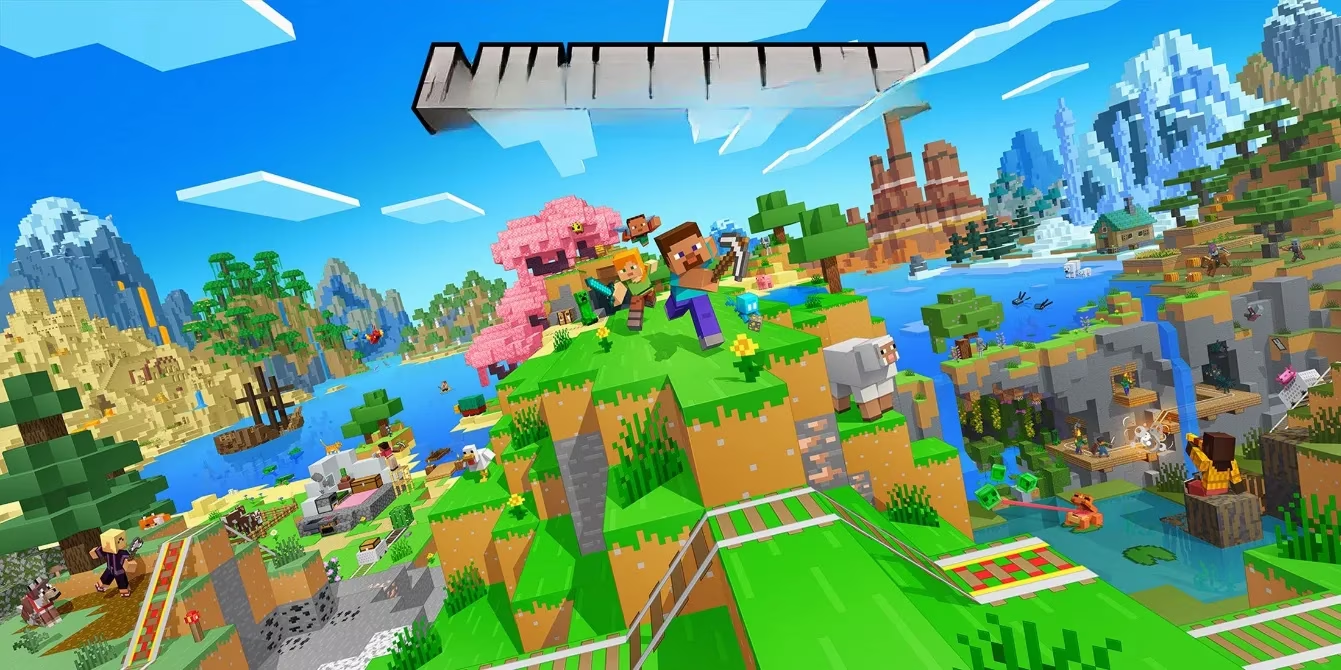
The Great Potato Cascade of 2025
The story goes like this: a player, whose username is lost to server logs, constructed an underground potato farm of truly monstrous proportions. We're talking hundreds upon hundreds of plants, all neatly lined up in a deep, cavernous pit. The setup was simple yet devastatingly effective. A single lever was connected to a network of pistons or block-updating mechanisms designed to harvest every single plant simultaneously. When the fateful lever was pulled... well, let's just say the game had a serious "spud" overload.
In a glorious 25-second clip that circulated like wildfire, you can see the player bravely (or foolishly) descending into the pit and throwing the switch. What followed wasn't a bountiful harvest, but a digital catastrophe. Thousands of potato items tried to pop into existence at the exact same moment. With each plant capable of dropping two to five potatoes, the game's engine was suddenly asked to process a tidal wave of starchy produce. It couldn't. The frame rate plummeted to zero, the world froze, and Minecraft simply gave up, crashing back to the desktop. Talk about too many cooks—or in this case, tubers—spoiling the broth!
Why Did the Game Break?
Other savvy players in the comment sections quickly diagnosed the issue. Minecraft, for all its magic, is still software running on hardware. Processing the creation, physics, and rendering of thousands of new item entities in a single tick (the game's internal heartbeat) is a Herculean task. It's like asking a single cashier to check out an entire stadium's worth of customers at once—chaos is the only possible outcome. The game's logic just got buried under a mountain of virtual potatoes.
| The Breakdown | What Happened |
|---|---|
| Trigger | Single lever harvesting hundreds of plants. |
| Event | Thousands of potato items spawned simultaneously. |
| Result | Game engine overload, leading to a crash. |
But Wait, There's More Spud!
Believe it or not, that game-crashing farm wasn't even the biggest potato operation in Minecraft history. Oh no, the community's appetite for agricultural excess knows few bounds. Just a few months prior, another dedicated farmer showcased a Survival Mode masterpiece containing a mind-boggling 205,876 potato plants. They reportedly spent 16 in-game days—which translates to over five hours of real-time digging, planting, and watering—to create this monolithic farm. Now that's commitment. One has to wonder what they planned to do with all those potatoes. Feed an army of zombie villagers? Build a potato castle? The world may never know.
A Legacy of Limit-Pushing Creativity
This potato pandemonium is just one drop in the ocean of Minecraft's player-driven wonders. Since its beta days back in 2009, the game has sold over 300 million copies by 2023, becoming the best-selling game ever, precisely because it gives players this sandbox to do... well, anything. We've seen players spend 3.5 real-world years building a utopian futuristic city inside a glass dome—a project that took 10,000 in-game days in Survival Mode. If you can dream it, someone in Minecraft is probably already building it, block by block.
And the tools keep getting better. Remember the Bundles of Bravery update that rolled out a while back? That update introduced the eerie Pale Garden biome, with its thick, grey foliage and tree-like monsters that stalk the night. It gave builders a whole new palette of fear and beauty to work with. Who's to say the next game-breaking creation won't be a haunted potato farm in the Pale Garden? The possibilities are, as always, endless.
So, here's to the Minecraft players who look at a simple crop and see not food, but a challenge. They ask not "how many potatoes do I need?" but "how many potatoes can my computer handle before it cries for mercy?" Their creations, from the sublime to the ridiculous (and the ridiculously sublime), are what keep this blocky world spinning. Just maybe, next time, save your game before you pull that harvest lever, okay folks? 😉
The following breakdown is based on reporting and developer-focused perspectives from Game Developer, where discussions around performance bottlenecks often emphasize how entity-heavy events can overwhelm simulation and rendering pipelines. In Minecraft-style sandboxes, mass-harvesting a huge crop field can force the game to spawn and update thousands of item entities at once, turning a single lever pull into a worst-case stress test that tanks tick rate, spikes memory/CPU load, and can ultimately trigger a crash when the engine can’t keep up.